

Jackie's Angels INC|Hospice as an Honor A Families Last Loving Moments
Updated: 1 day ago
Hospice can sound like a door closing. For Jackie’s family, it became something quieter and more sacred: a room where love could finally take its time.
The word carries weight. Many people hear it and think only of loss, hospital beds, and the unbearable countdown of days. Yet hospice can also become a gift. It can offer a family space to breathe, to speak, to forgive, to remember, and to honor a life while that life is still being lived.
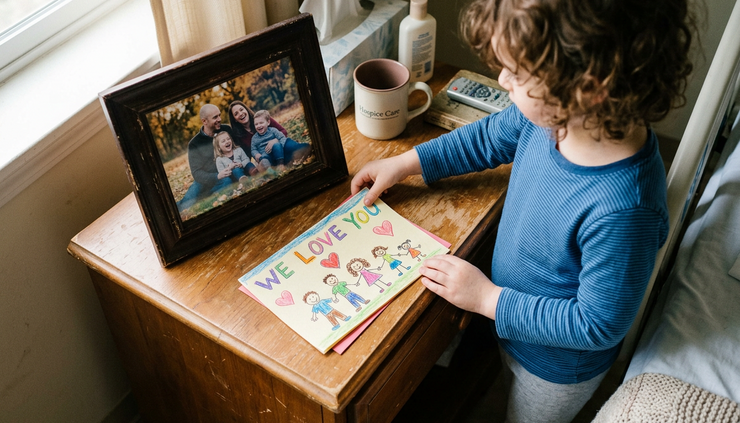
For Jackie, hospice was not a grim ending. It was a season of final touches. Her young children had time to love her in ways they could understand. They made cards. They sat near her. They became part of photographs that would one day carry more meaning than they could fully grasp at the time. Those photos were not taken to preserve sadness. They were taken to protect joy, tenderness, and proof that love was present.
The family was given months. Not as many as anyone would have wanted, but enough to create moments that would stay. Enough to say things. Enough to let small hands place paper cards where words had failed. Enough to give Jackie honor, not only care.
This reflection is personal and informational, not medical advice. Families facing hospice decisions should speak with their care team about their own needs, options, and timing.

Jackie's Angels INC|Hospice as an Honor A Families Last Loving Moments| Hospice can hold more than sorrow
A hospice diagnosis often arrives after a long road. Families may have already watched treatments, appointments, waiting rooms, hard conversations, and changes no one felt ready to face. By the time hospice enters the conversation, everyone may feel tired in a way sleep cannot fix.
That is why hospice can be misunderstood. It may seem like surrender. It may feel like everyone is being asked to give up.
But hospice care, at its heart, centers comfort, dignity, and quality of life. It asks a different question. Instead of asking what else can be fought, it asks what can still be cherished.
For Jackie’s family, that shift mattered. The focus moved toward presence. The days were no longer measured only by medical updates. They were measured by visits, by drawings, by laughter that surprised everyone, by the way her children could crawl close and simply be near their mother.
Hospice as an Honor A Familys Last Loving Moments is more than a title. It names a truth many families discover only after they have lived it. There can be honor in washing a face gently. There can be honor in brushing hair. There can be honor in helping children bring their love into the room without fear swallowing the moment whole.
Hospice does not erase grief. It does not make the ending easy. Nothing can do that. But it can soften the sharpest edges by giving a family permission to focus on what matters most.
For some families, that means prayer. For others, music. For others, quiet. For Jackie, it meant giving her children a place in the story, not shielding them so completely that they were left outside of it.
Children need honest love at the bedside
Adults often want to protect children from pain. That instinct comes from love. A parent, grandparent, aunt, uncle, or family friend may worry that the sight of illness will be too frightening. They may wonder whether children should remember someone only as healthy and strong.
Yet children often know more than adults realize. They sense changes in the home. They notice whispers, tears, and sudden silences. When they are kept too far away, their imagination may create something scarier than the truth.
Jackie’s children were young, but their love was real. They did not need a perfect explanation for every medical detail. They needed safe ways to express what their hearts were carrying.
Cards gave them that. A card can hold a drawing, a heart, a shaky signature, a sentence that says “I love you” in the simplest way. It can hold sadness without asking a child to explain it out loud. It can become a bridge between what a child feels and what a parent receives.
Photos gave them something different. They gave the children future proof.
One day, when they are grown, they will be able to see themselves beside their mother. They will see that they were there. They will see hands held, cheeks close, small bodies leaning in. They may notice details they could not notice then: the way Jackie looked at them, the tenderness in the room, the effort everyone made to create beauty in a hard season.
Those images may bring tears first. Later, they may bring smiles. Often, the same photo does both.

Photographs can become a kindness to the future
Taking photos during hospice can feel uncomfortable at first. Some families wonder whether it is appropriate. They may worry it will make the moment feel staged or intrusive. That concern is understandable. No one wants to turn suffering into a performance.
But photographs do not have to be polished. They do not have to hide the truth. The most meaningful images are often quiet and ordinary.
A child’s hand in a mother’s hand.
A card propped near a pillow.
A family curled together at the bedside.
A smile that lasted only a second.
A favorite blanket. A necklace. A stuffed animal. A window with late-day light coming through.
These images can help family members remember more than the illness. They can preserve the love that surrounded it.
For Jackie’s children, the photographs were not only keepsakes. They were gifts sent forward in time. Young children may not remember every visit clearly. They may remember a feeling, a smell, a song, or a fragment. Photos can help them build a fuller picture later.
When they become grown people, those images may answer questions they did not know how to ask as children.
They may ask, “Was I there?”
The photo can say yes.
They may ask, “Did she know I loved her?”
The photo can say yes.
They may ask, “Did she look at me that way?”
The photo can say yes.
That kind of evidence matters. Grief can blur memory. Childhood grief can be especially difficult because so much understanding comes years later. Photos can become anchors.
They do not need to show only smiles. A peaceful image can hold both truth and tenderness. A tear in the frame does not ruin the memory. It can show how deeply someone was loved.
Cards can carry words that are hard to say
Hospice often opens space for unfinished conversations. Some are spoken clearly. Others come out in pieces. Some arrive through tears, jokes, stories, apologies, or long silences.
For children, a card can carry what their voice cannot.
A child may write:
“I love you.”
“I miss playing with you.”
“You are the best mom.”
“I hope you like my picture.”
“I am sorry I got mad.”
Adults sometimes call these “little” messages. They are not little. They are direct, honest, and full of feeling.
The brief mentioned “undo feelings,” the emotions children carried that still needed a place to go. That phrase holds something true. Children can carry confusion, guilt, anger, fear, and love all at once. They may worry they did something wrong. They may feel upset that their parent cannot play the same way. They may feel angry at the sickness, then guilty for feeling angry at all.
A card gives those feelings somewhere gentle to land.
It also allows the parent to receive love in a form that can be held. Even when energy is low, the presence of a child’s drawing can brighten the bedside. It says, “You are still my person. I am still reaching for you.”
Adults need that too.
Hospice can create a strange kind of pressure. Everyone wants to say the right thing. Families may worry that every conversation has to be deep, final, or perfect. It does not. Love often comes through small honest offerings.
A card.
A song.
A favorite snack.
A story that has been told many times.
A blanket tucked around the shoulders.
A child whispering, “Look what I made.”
The final season of life does not have to be filled only with final words. It can be filled with familiar love.

The blessing of having months
No amount of time feels like enough when someone is loved. A year would not be enough. A decade would not be enough. Love always wants more.
Still, the months Jackie’s family received became a blessing. They gave the family a chance to move from shock into intention. There was time to notice what mattered. Time to take pictures. Time for the children to make more than one card. Time for visits that were not rushed. Time for ordinary moments to become precious.
That time did not remove pain. It gave the pain a place to sit beside gratitude.
There is a particular tenderness in knowing time is limited. The ordinary becomes brighter. A hand squeeze matters. A laugh becomes a treasure. A calm afternoon feels holy. Even a difficult day can hold a small mercy.
Families often look back and remember the smallest details:
The color of the blanket
The sound of a child laughing in the hall
The way sunlight moved across the room
The smell of lotion
The last time everyone was gathered together
The card that stayed on the bedside table
The photo that captured a mother’s eyes on her children
These are not minor things. They become part of the family’s shared history.
When months are given, they can be used gently. Not every day needs a plan. Not every visit needs a purpose. Some days are for rest. Some are for sadness. Some are for letting children be children nearby, because their normal play can bring life into the room.
The blessing is not that loss is avoided. The blessing is that love has time to express itself.
Honoring a life means seeing the whole person
Illness can shrink the way people talk about someone. A person may become a diagnosis, a care plan, a medication schedule, or a list of symptoms. Families do not mean to do this. Medical needs can become urgent and consuming.
Hospice offers a chance to widen the view again.
Jackie was not only someone receiving care. She was a mother. She was someone whose children loved her. She was someone with a life behind her, stories behind her, and relationships shaped over years. She deserved to be seen in that fullness.
Honoring someone in hospice can look simple:
Tell favorite stories
Keep meaningful objects nearby
Let children participate safely
Take gentle photos
Say what can still be said
Invite family members to share memories out loud, even the funny ones.
Photos, blankets, cards, books, or small keepsakes can make the space feel personal.
Drawing, singing, reading, or sitting nearby can help them feel included.
Capture connection without forcing smiles or poses.
Love, gratitude, forgiveness, and reassurance matter, even in short sentences.
None of these acts require a perfect family. Hospice does not magically fix every wound. Some families carry complicated histories. Some relationships include regret, distance, or words left unsaid for years.
That does not make final moments any less sacred. Sometimes honor looks like reconciliation. Sometimes it looks like sitting quietly without solving everything. Sometimes it looks like allowing a child to say, “I love you,” without asking them to carry adult grief.
For Jackie’s family, honor came through presence. The children were not props in a sad scene. They were her children loving her. Their cards, photos, and closeness became part of the care itself.
The blessing of having months
People sometimes feel guilty when they notice gratitude during hospice. They may think, “How can I feel thankful when this is happening?” Yet gratitude during grief is not denial. It is a way of recognizing the love still present.
A family can hate the illness and still feel thankful for a peaceful afternoon.
They can cry over what is coming and still smile at a child’s drawing.
They can feel exhausted and still know that the time together matters.
This mix of emotions can be confusing, especially for children. Adults can help by naming feelings in plain language. Simple sentences work best.
“We are sad because we love her.”
“She is very sick, and we are taking care of her.”
“Your card made her happy.”
“It is okay to cry.”
“It is okay to laugh too.”
Children do not need long speeches. They need steady truth, repeated with warmth. They need to know their feelings are allowed. They also need to see that love continues even when everyone is sad.
That may be one of the deepest honors hospice can offer. It allows love to remain active. Family members still get to care. Children still get to give. The person in hospice still gets to receive.
The last loving moments still belong to life
The final chapter is still part of the story. It should not be treated as an empty space before loss. For Jackie and her family, those months held meaning. They held care, photographs, cards, conversations, and the kind of closeness that becomes part of a family forever.
Hospice did not make the goodbye easy. It made room for love to be practiced slowly and intentionally.
That is the honor.
To sit with someone at the edge of life is to say, “You still matter. Your comfort matters. Your memories matter. Your children’s love matters. Your story is still being held.”
Jackie’s children may grow up with questions, grief, and moments when they wish they had more time. They will also have evidence of love. They will have images that show they were included. They will have the knowledge that their cards reached her. They will have a family story that says the last months were not only about dying. They were about loving well.
Hospice can be tender, painful, and beautiful all at once. When a family is given time, even imperfect time, it can become a blessing. It can become a chance to make the final touches to a life well spent.
And sometimes, those final touches are made with crayons, photographs, small hands, and a love that keeps speaking long after goodbye.
Jackie's Angels INC|Hospice as an Honor A Families Last Loving Moments


Comments